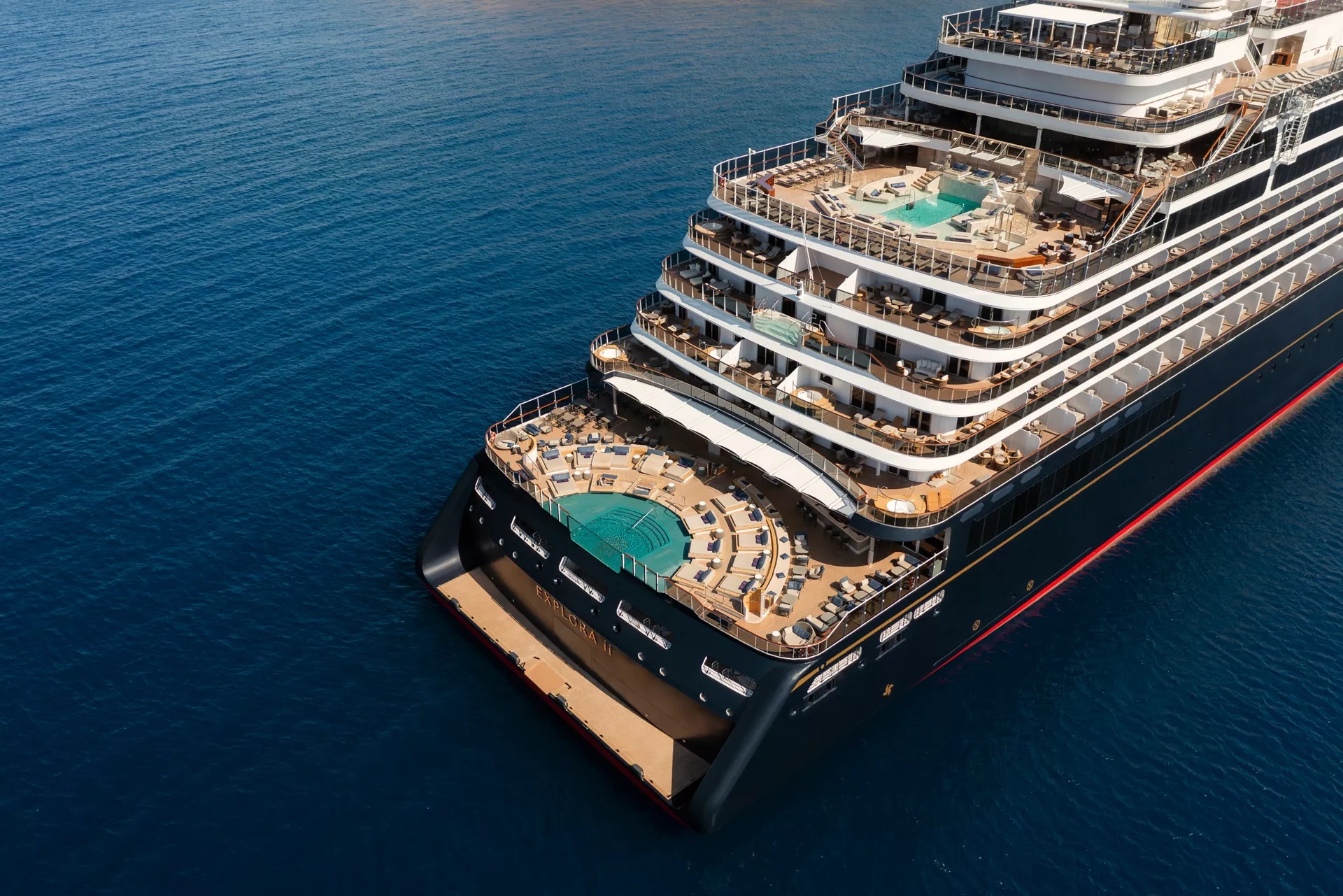

Somewhere in the South Pacific, the ship is moving through glassy water at dawn. You have coffee in hand, no flights to catch, and Bora Bora behind you and Japan ahead. That's a Tuesday on a world cruise.
This kind of trip isn't reserved for retirees with unlimited budgets. It's for anyone who wants to stop moving through the world in two-week windows — and start actually living in it.
At a Glance
- World cruises typically run 100 to 140 days and visit 40 to 60 ports across multiple continents
- They're offered by luxury and premium lines including Regent Seven Seas, Silversea, Cunard, Viking, and Holland America
- Pricing starts around $20,000 per person and climbs well past $100,000 for ultra-luxury suites
- You don't have to do the full voyage — many lines offer segment bookings of 2 to 6 weeks
- The traveler profile is broader than most people assume: remote workers, recently retired couples, and serious collectors of experience all book these trips
What Does a World Cruise Actually Look Like?
Most world cruises depart in January and return in April or May. That calendar isn't arbitrary. It threads together the Southern Hemisphere summer, the dry seasons across Southeast Asia and India, and the Mediterranean spring — all in sequence, without backtracking.
A typical itinerary might open in Fort Lauderdale or Los Angeles, cross the Pacific to Hawaii, then arc south to French Polynesia and New Zealand. From there, the ship moves through Southeast Asia, India, the Arabian Peninsula, East Africa, and eventually into the Mediterranean before returning home.
The ship becomes your home base. Ports change daily or every two days, but your cabin, your routine, and your dining companions stay constant. That rhythm is exactly what long-voyage travelers love most.
Who Actually Books a World Cruise?
The assumption is that world cruises are for retirees with nothing but time. That's partially true — but only partially.
The traveler profile has shifted noticeably. You'll find couples celebrating a milestone, professionals taking a once-in-a-career sabbatical, and a growing number of location-independent workers who realized a ship's Wi-Fi is as reliable as their home office. The segment booking option has also opened the door for travelers who can carve out four to six weeks but can't commit to four months.
Retirement is still the most common trigger. For travelers who've spent decades planning two-week vacations, a world cruise is often the first trip where the destination isn't rushed. Spending three days in Mumbai instead of three hours changes how you experience a place. That depth is the real product being sold.
How Do the Major World Cruise Lines Compare?
Not all world cruises are built the same. The line you choose shapes everything from ship size to how many sea days you'll have.
| Line | Ship | Approx. Duration | Style |
|---|---|---|---|
| Regent Seven Seas | Seven Seas Mariner | ~130 days | Ultra-luxury, all-inclusive |
| Silversea | Silver Dawn or Silver Whisper | ~115–140 days | Ultra-luxury, small ship |
| Cunard | Queen Mary 2 or Queen Victoria | ~100–110 days | Classic ocean liner, formal |
| Viking | Viking Star or similar | ~120–140 days | Destination-focused, no casinos |
| Holland America | MS Rotterdam or MS Volendam | ~120–130 days | Premium, multigenerational |
Regent Seven Seas and Silversea are worth comparing carefully if you're leaning toward ultra-luxury. The differences in included excursions, butler service, and suite categories matter significantly on a voyage this long.
Dreaming of your next voyage?
Let a Cruise Planners advisor build you a custom itinerary — no booking fees.
Viking tends to attract travelers who prioritize port time and immersive programming over shipboard entertainment. Cunard skews more formal and is one of the few lines where black-tie evenings still feel entirely natural.
What About Segment Cruises?
Segment bookings are one of the most underused options in cruise planning. Most world cruise lines allow you to board and disembark at interim ports — so instead of 130 days, you might book 30 days from Singapore to Athens.
This approach makes a world cruise route accessible without the full time commitment or cost. You still get the itinerary depth — back-to-back ports, overnight stays, region-specific excursions — without restructuring your entire year.
For travelers who are curious about extended voyaging but haven't done it before, a well-chosen segment is a practical first step. The Panama Canal segment on a world cruise, for example, pairs some of the most iconic sailing in the world with Caribbean and Pacific stops on either side.
What's It Like to Actually Live on a Ship for Months?
This is the question that separates the curious from the committed. Living aboard for 100-plus days requires genuine comfort with close quarters, sea days, and a social environment you can't entirely opt out of.
The experienced world cruise traveler will tell you the sea days are the point. Time to read, to write, to finally take the cooking class or the language lecture you always meant to do. Ships on extended voyages load their programming calendar with guest lecturers, regional experts, and enrichment series tied to the ports ahead.
Did you know that some world cruise passengers book the same voyage multiple years in a row — and specifically request the same cabin? The ship community that forms over 130 days is genuinely hard to replicate elsewhere.
The honest challenge is isolation from home. Birthdays are missed. Grandchildren grow. Time zones shift constantly. Travelers who thrive on world cruises tend to be emotionally self-sufficient and genuinely curious about the people around them — on the ship and in every port.
Why Working with an Advisor Changes the Outcome
World cruises are among the most complex bookings in travel. Suite categories sell out 18 to 24 months in advance on the most sought-after voyages. Segment availability is limited and not always visible through consumer-facing booking tools. Air deviation programs, pre- and post-cruise hotel arrangements, and visa logistics across 40-plus countries require coordination that a single booking window doesn't support.
An experienced cruise advisor — one who works with these lines regularly — knows which segments offer the strongest itinerary value, which cabin categories are worth the upgrade, and how to structure the booking to protect your investment with the right travel protection. That expertise doesn't cost you more. In most cases, the advisor's fees are covered by the cruise line.
When you're ready to explore what a world cruise could look like for your timeline and travel style, reach out to Ohana Cruises. There's no pressure and no generic brochure — just a real conversation about what's possible.